
Pickerington, OH · Garage Door Service
Garage Doors Built for Pickerington's Cold Winters
Pickerington's garage doors mostly date from the 1960s and 70s, built before modern insulation codes, and Ohio's cold winters find every weak spring and seal.
- Repairs & new doors
- Springs & openers
- Serving 4 nearby communities
What Most People Get Wrong
Most homeowners here assume a noisy or sticking door means the opener motor is on its way out. It's usually not. Pickerington's housing stock runs from 1938 to 2006, with the median year sitting at 1977, and across the service area the bulk of the stock dates to the 1960s and 70s spread over 28 named communities. A door and spring set installed in that window was built for a different pace of use than a two-car household running the opener six or eight times a day now.
The spring, not the motor, is almost always what fails first on a house this age. Torsion springs have a rated number of cycles, and a 1970s install has usually eaten through that count years before anyone notices the slow-down or the hard stop. People replace the opener, the door still groans, and the actual part wears down further. We see this pattern a lot across the older sections near Canal Winchester and Blacklick Estates, where the housing ages line up with the same build window.
The honest limitation: if your door is original to a house built in the 1960s, parts for that exact track hardware aren't always on the shelf anymore. Sometimes replacement is the faster, cheaper call than chasing a part for obsolete hardware.
The Seasonal Bit
Pickerington sits in a cold-climate band rated severe, and that matters more for a garage door than most owners think. Steel contracts in the cold. A torsion spring that's tensioned correctly in July can bind or lose consistent pull by January, especially once it's already past the newer end of its cycle life on a house from the 1960s or 70s.
Lubricant thickens in low temperatures too, which is why a door that opens fine most of the year suddenly groans or hesitates on the coldest mornings. Rollers and hinges on original hardware feel it first, since they weren't built with today's weatherized nylon or sealed bearings.
We don't push a seasonal tune-up as a blanket fix for every house. On newer doors, often fine to skip a year. On the older stock that makes up most of this area, though, a cold snap is when a spring that's already near the end of its life finally lets go, usually on the coldest morning of the year, which is the worst time to be without a working door.
The Situation
The service area runs from South East and Southside four miles out to Worthington, twenty miles north, with 28 named communities in between - Canal Winchester, Blacklick Estates, Lithopolis, Etna, Groveport, and the rest. That's 55,641 households and 32,679 owner-occupied houses spread across a mix of build decades, though the center of gravity is still that 1960s-70s stretch.
Median household income in the area sits at $92,335. In practical terms, that shows up as more full door and opener replacements than patch jobs - when a 1970s door and a worn spring both need attention, a lot of owners here decide to just replace the whole unit rather than keep paying for one more repair on hardware that's near the end of its life anyway.
It also means insulated steel doors have become the common upgrade instead of the original uninsulated panel doors that came standard on houses built before insulation rules tightened. That one change does more for a cold garage than almost anything else we install.
What the Weather Here Does to It
A severe cold-climate rating isn't just about the coldest day of the year - it's the swing between a 60-degree afternoon and a 20-degree night that does the damage. Steel panels expand and contract with that swing, and on an original 1960s or 70s door without insulation, there's nothing buffering the metal from it. Over enough winters the panels warp at the seams, and the weatherstripping along the bottom and sides cracks and stops sealing.
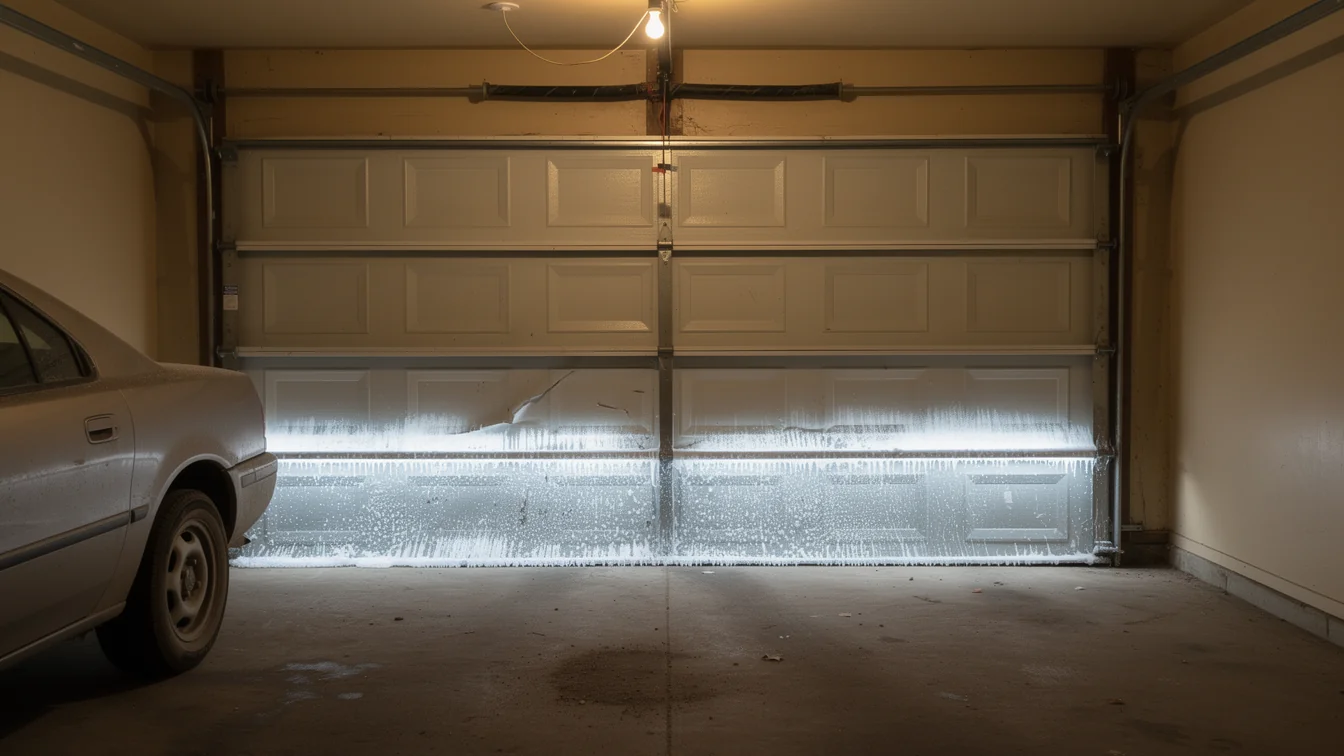
Condensation is the other half of it. A cold, uninsulated steel door in a heated garage sweats on the inside face, and that moisture finds its way into the bottom panel and the track hardware, which speeds up rust on parts that are already decades old.
We can't make a 50-year-old uninsulated door perform like a new one - at some point the fix is a new insulated door, not another seal kit. But on doors from the newer end of the area's build range, from the 1990s and 2000s, a seal and hardware service usually gets several more winters out of what's there.
Frequently asked questions
Why does my garage door stick worse in the winter?
On a house built in the 1960s or 70s, the torsion spring and track hardware are original or close to it, and steel contracts in cold weather. That tightens tolerances in the track and thickens old lubricant, so a door that runs fine in summer binds or hesitates once temperatures drop into the severe range we get here.
Is it worth replacing an old uninsulated door instead of repairing it?
Often yes. If the door is original to a house from the 1960s-70s era common across this area, you're usually dealing with a worn spring, cracked seals, and no insulation all at once. Given median incomes here, a lot of owners find a full insulated replacement cheaper over time than repeated patch repairs on hardware near the end of its life.
Do you service areas outside Pickerington itself?
Yes, the service area covers roughly 28 named communities within about 20 miles, from South East and Southside closer in to Canal Winchester, Blacklick Estates, Groveport, and out to Worthington. Distance and drive time can affect scheduling, so it's worth asking when you call.
Related garage door services in Pickerington
More garage door guides
Book garage door service in Pickerington
Call now or request a quote - tell us what the door is doing and where you are.