
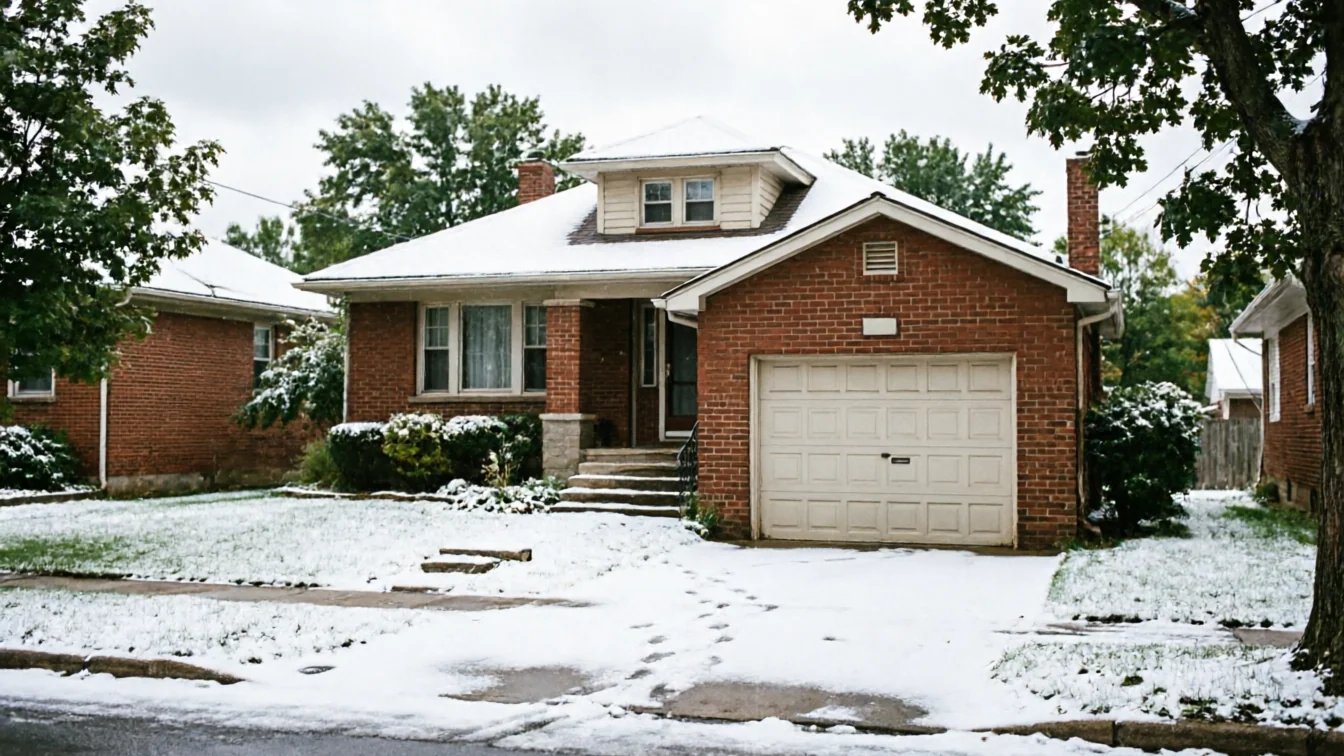
Pickerington, OH · Garage Door Service
Why Pickerington Garage Doors Fail in Winter, Not Summer
Pickerington homes built mostly in the 1960s-70s run original torsion hardware that struggles once winter sets in. We explain why, and what actually breaks first.
- Repairs & new doors
- Springs & openers
- Serving 4 nearby communities
What Most People Get Wrong
Most calls we get start the same way: the opener hums, the door doesn't move, so the owner assumes the opener is dead. Nine times out of ten in this area, it isn't. Pickerington's housing stock runs from 1938 to 2006, with most of it dating to the 1960s and 70s, and that generation of door came with torsion springs sized for the hardware of the day. Those springs don't fail because they're old in some abstract sense. They fail because years of temperature swings fatigue the steel, and the opener - which was never designed to lift a door against a dead spring - just strains against the weight until the gears strip or the motor burns out trying.
So the opener gets blamed, and sometimes replaced, while the actual problem (a spring that snapped or lost tension) goes untouched. We see this a lot in the 1960s-70s stock specifically, because that's the era where side-mounted torsion setups were standard before manufacturers moved to the extension and center-mount designs you see in newer builds. If your house falls in that build window, a dead opener and a broken spring are more likely to be the same call.
The Seasonal Bit
Pickerington sits in a climate band that federal data classifies as cold and severe, which matters more for a garage door than most people think. Torsion springs are tempered steel, wound tight and holding all the weight of the door. Steel contracts in cold, and a spring that's already fatigued from age or daily cycling loses whatever margin it had left right around the point the temperature drops hard. That's why so many of our calls cluster in the cold months rather than spread evenly across the year - it isn't that doors get used more in winter, it's that marginal springs that would have lasted another year in a milder climate don't get that extra year here.
The practical result: if your spring looks original and your house is part of that 1960s-70s wave, a hard cold snap is exactly when it's most likely to let go. We'd rather replace a spring on our schedule than get the call at 7am when it's snapped and the door's stuck half-open.
The Situation
Across the service area there are 55,641 households and 32,679 owner-occupied houses, most of them carrying the same vintage of garage door hardware that came standard when they were built. With a median household income of $92,335 for the area, most owners we talk to choose a full spring replacement over a patch job once they understand what's actually failing - the labor cost of a return visit for the same part usually isn't worth the short-term savings.
Pickerington itself sits among a cluster of nearby communities - Canal Winchester four miles off, Groveport seven, Blacklick Estates and Lithopolis six - but the work we do inside Pickerington is shaped by what's actually on these streets: doors and springs from that long 1938-2006 build window, with the heaviest concentration in the 1960s and 70s. That's the stock we're set up to service, and it's why we ask the age of the house before we ask what the door is doing.
What the Weather Here Does to It
In a cold-severe climate, the garage door takes a beating in ways that don't show up until something snaps. Steel tracks contract and can pull slightly out of alignment over repeated freeze-thaw cycles. Rollers that were fine in October start binding once the grease inside them stiffens in sustained cold. And springs - again - are the part doing the most work under the most stress, holding tension through temperature swings they were never recalibrated for after installation.
One honest limitation: we don't stock every spring size for every era of door on the truck. The 1960s-70s stock common here mostly uses sizes we carry, but older builds from the 1938-1950s range sometimes need a part ordered in, which can mean a day or two wait rather than a same-visit fix. We'll tell you upfront if that's the case rather than make you wait to find out.
Frequently asked questions
Why did my garage door spring break in the middle of winter and not before?
Spring steel loses some of its tolerance as it ages, and a cold snap is often what pushes a fatigued spring past the point it can hold. Pickerington's climate is classified cold-severe, so that cold-weather failure point tends to come sooner here than in a milder region.
My house was built in the 1960s - does that matter for the repair?
It does. Houses from that era, which make up a large share of the stock in this area, typically have side-mounted torsion hardware. We need to know that going in, since parts and spring sizing differ from newer center-mount setups.
Should I replace the opener or the spring first?
If the door is heavy to lift by hand and the opener strains or won't move it, start with the spring. An opener working against a dead spring will eventually fail too, and replacing the opener alone won't fix the underlying problem.
Do you have every spring size on the truck?
Usually, for the common 1960s-70s era doors in this area. Older houses near the start of the 1938-2006 build range sometimes need a less common size ordered in, which can add a day or two to the job.
Related garage door services in Pickerington
More garage door guides
Book garage door service in Pickerington
Call now or request a quote - tell us what the door is doing and where you are.